


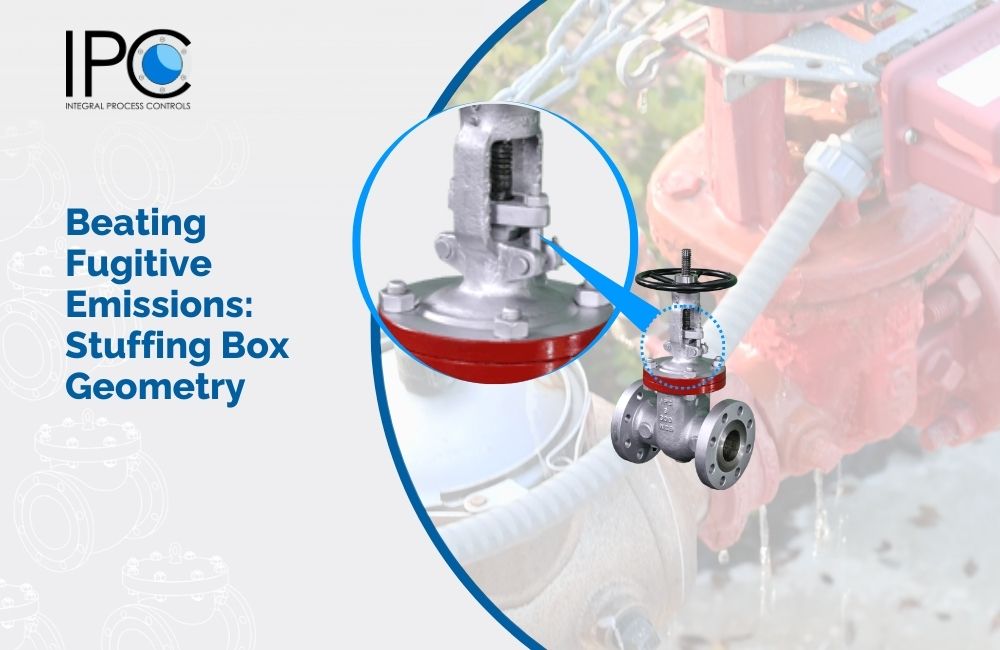
Fugitive emissions are the tiny, often invisible leaks that escape around moving parts. In a valve, the front line is the stuffing box, the chamber around the stem where packing rings create the seal.
When this geometry is right and the packing is matched to the service, leak rates fall dramatically. When it isn’t, plants chase re-tightening, rising Leak Detection and Repair counts and avoidable downtime.
How Stuffing box geometry Matters in Fugitive Emission Scope
Think of the stuffing box as a pressure sleeve that must grip evenly while letting the stem move. That balance lives in a few details. Diametral clearance between stem and bore has to be tight and true so the packing isn’t pushed into gaps. Depth must allow the correct number of rings so load is shared through the whole stack, not crushed at the top.
Compression should be straight and centered; a guided gland follower helps keep force where it belongs. With these three elements clearance, depth and ring count, and controlled compression the seal sits in the “sweet spot” longer, even as the valve cycles.
ISO 15848 gives industry a common yardstick
A way to test valves for low emissions under defined temperature, pressure, and cycling. It sets measurable limits for leakage at the stem and specifies test classes so buyers can compare apples to apples. For plants, this links directly to LDAR programs and Environmental, Social and Governance (ESG) reporting for maintenance teams, it means fewer adjustments and more predictable performance.
The IPC Way
At IPC, the design work starts at the stuffing box. We hold close tolerances on the bore and stem, design depth for the right ring count, and use guided followers to keep compression uniform. Packing selection is matched to media and temperature, and sealing surfaces are finished to a repeatable standard. The outcome is simple to live with: lower leak rates, cleaner audits, and valves that keep what’s inside… inside.