


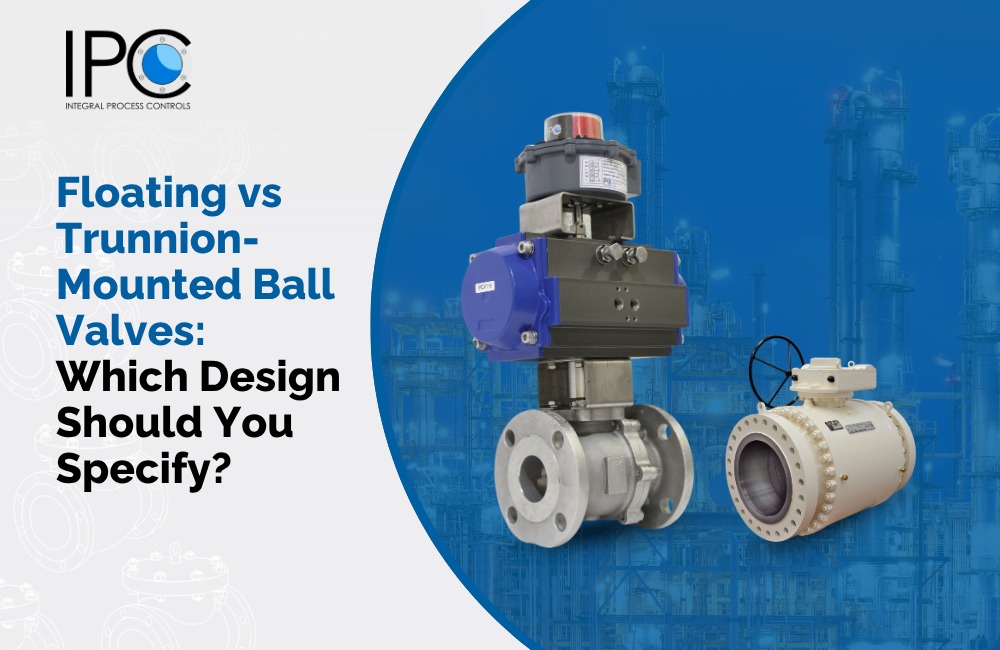
The ball valve choice that can change torque, cost and long-term reliability
At the RFQ stage, a floating ball valve and a trunnion mounted ball valve can look very similar.
Both are quarter-turn isolation valves. Both can be supplied in similar materials. Both may meet the same pressure class.
But their internal design is different. That difference affects seat loading, operating torque, actuator size and long-term sealing performance.
This is where valve selection needs more than a catalogue comparison.
How the two designs work
In a floating ball valve, the ball is supported mainly by the seats. When line pressure rises, the ball moves slightly towards the downstream seat. This creates the sealing force.
In a trunnion mounted ball valve, the ball is supported at both top and bottom trunnions bearings, minimising seat loading and reducing operating torque.
Selection factor | Floating ball valve | Trunnion mounted ball valve |
Typical fit | Smaller sizes and moderate-pressure duties | Larger sizes, higher pressures and critical duties |
Ball support | Supported by seats | Supported by top and bottom trunnions |
Seat load | Increases with differential pressure | Better controlled through seat design |
Operating torque | Can rise at higher pressure | More predictable for high-pressure duties |
Automation | May need a larger actuator at high differential pressure | Often suited to need smaller actuator as torque less. |
When should you specify a floating ball valve?
A floating ball valve can be a practical and economical choice for standard isolation duties.
It works well when the size is manageable, the differential pressure is understood and the actuator is correctly sized.
But at higher pressure, seat loading can increase breakaway torque. If this is missed, the selected actuator may struggle to operate the valve. Seat wear can also become a concern.
When does a trunnion mounted ball valve make more sense?
A trunnion mounted ball valve is commonly selected for high-pressure, large-bore or critical isolation service.
The supported ball design helps control seat load. It also supports more predictable torque values. This is important for pneumatic and electric actuation.
For double-block-and-bleed expectations, buyers should define the actual DBB design, test requirement and documentation need. A DBB trunnion ball valve should be selected against the process requirement, not only against a generic description in the RFQ.
How IPC helps buyers make the right call
IPC starts with the operating duty, not just the valve type.
The review includes valve size, pressure class, maximum differential pressure, media, temperature, cycling frequency, required leakage performance and actuation method. IPC then reviews the expected torque at the critical operating condition.
This helps determine whether a floating ball valve remains suitable or whether a trunnion mounted ball valve adds real value.
IPC can also guide buyers on seat and trim selection, actuator sizing, DBB expectations, testing requirements and MDR documentation. This makes it easier to compare offers on a like-for-like technical basis.
When reviewing trunnion ball valve manufacturers, buyers should ask for torque data, seat design details, pressure-temperature limits, test procedures and traceability records.
The right ball valve is not simply the lower-cost option.
It is the design that is proven for the process duty and supported with the right engineering evidence.