


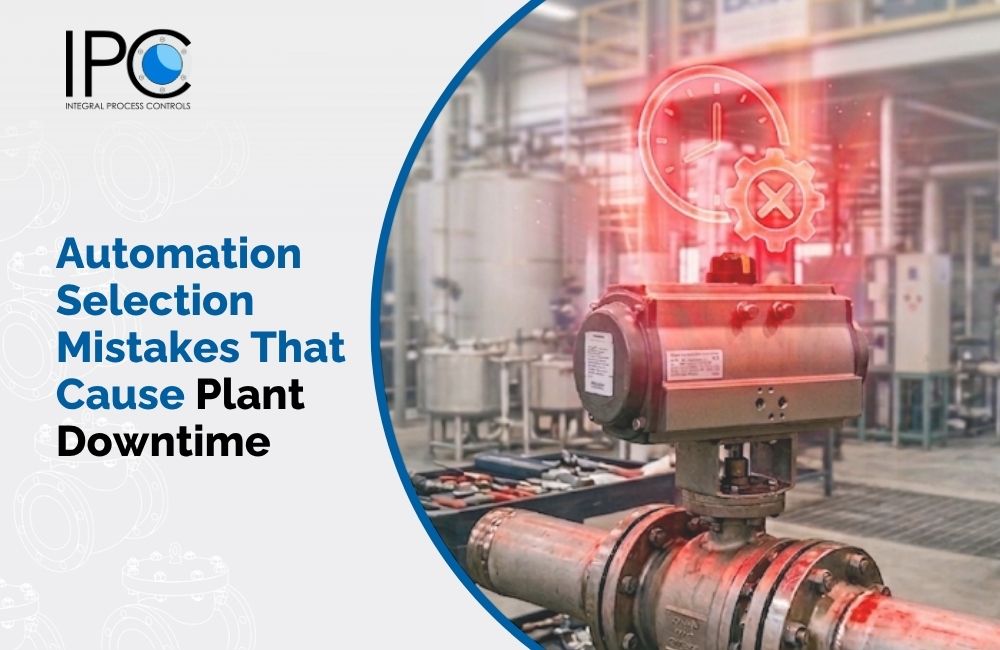
The High Cost of a Misconfigured Actuator
A valve that doesn’t open when commanded, or one that slams shut with destructive force, isn’t just an inconvenience it’s a production killer. In automated process plants, actuator selection mistakes are a leading cause of unplanned downtime. And the root cause is almost always the same: treating the actuator as an afterthought rather than a critical component of the automated valve assembly.
Our experts have covered the three most common automation selection mistakes and how to avoid them ensuring reliable operation, fewer nuisance trips, and easier future upgrades.
#1 Mistake : Wrong Sizing / Insufficient Torque Margins
What Goes Wrong
The actuator is selected based on the valve’s “catalog” torque often the running torque. But real-world conditions are harsher:
- Breakaway torque is significantly higher than running torque, especially after the valve has been stationary for a long time.
- Process pressure increases seat friction.
- Temperature changes affect packing friction and thermal expansion.
- Supply pressure may dip during peak demand.
Result: The actuator cannot move the valve. The valve sticks, the process trips, and production stops.
How to Avoid It
- Size on breakaway torque, not running torque.
- Apply a safety margin of at least 25-30% for pneumatic actuators.
- Verify the actuator output at the minimum available supply pressure, not the ideal pressure.
- Check the torque curve some actuators lose torque at the stroke ends.
IPC’s approach: We ask for your full process conditions pressure, temperature, cycling frequency and size the actuator with a realistic margin.
#2 Mistake : Wrong Accessories or Mounting Interface
What Goes Wrong
The valve and actuator bolt together, but:
- The solenoid valve doesn’t match the control signal (e.g., 24VDC vs. 110VAC).
- The limit switch box has the wrong electrical rating.
- The mounting bracket is improvised, leading to misalignment and stem binding.
- The interface doesn’t comply with ISO 5211 or NAMUR, making future replacement or upgrade a custom engineering project.
Result: The valve operates intermittently, trips during startup, or cannot be integrated into the DCS. Maintenance teams waste hours with adapters and field fixes.
How to Avoid It
- Specify the full accessory list (solenoid, limit switches, positioner, air set) as a complete package.
- Verify electrical compatibility (voltage, current, hazardous area rating) before ordering.
- Insist on standard interfaces: ISO 5211 for the mechanical connection, NAMUR for solenoid and switch mounting.
- Ask for a dimensional drawing of the complete assembly don’t assume it fits.
IPC’s approach: We supply fully assembled, tested packages – valve, actuator, solenoid, limit switch box, and bracket all on a single test stand. We also use standard interfaces (ISO 5211, NAMUR) for easy future upgrades.
#3 Mistake : Missing Fail-Safe & Duty Cycle Checks
What Goes Wrong
The actuator works perfectly during the factory test. But in the plant:
- The fail-safe action (spring-return vs. double-acting) isn’t matched to the safety requirement so on air failure, the valve stays put instead of going to a safe position.
- The duty cycle is too high for the actuator it overheats, motor burns out, or solenoid coil fails.
- The cycling speed is too slow for the process control.
Result: The valve fails to go to the safe position during an emergency, or it fails prematurely due to overheating/excessive cycling. Both lead to unplanned downtime and safety incidents.
How to Avoid It
- Define the required fail-safe action clearly: fail-open, fail-closed, or fail-in-last-position.
- State the maximum number of cycles per hour and the required stroke time.
- For control valves, confirm the actuator can achieve the required positioning speed and accuracy with the specified positioner.
- Check the temperature rating of the actuator and accessories, plant ambient conditions may be hotter/colder than the test room.
IPC’s approach: We ask for your safety requirement and duty cycle upfront. We then select actuators with the correct spring return, thermal protection, and cycle rating and we document the assembly’s performance.
Summary: Your Automation Reliability Checklist
Area | What to Check | IPC Advantage |
Sizing / Torque | Sized on breakaway + 25-30% margin at minimum supply pressure. | Full process condition review before selection. |
Accessories | Complete spec solenoid, switches, positioner with correct voltage/rating. | Fully assembled, tested packages with standard interfaces. |
Mounting | ISO 5211 standard; bracket alignment verified. | Dimensional drawings supplied; no field improvisation. |
Fail-Safe | Defined action (fail-open/closed/last); spring-return or double-acting correctly chosen. | Safety requirement documented and verified. |
Duty Cycle | Actuator rated for required cycles/hour and stroke time. | Temperature and cycle rating checked against plant requirements. |
Let IPC Valves helps Your Automation Specification
Before you finalize your next automated valve order, share your service conditions, safety requirements, and duty cycle with IPC. We will:
- Verify sizing and torque margins.
- Check accessory compatibility.
- Confirm fail-safe action and duty rating.
- Provide a complete, documented assembly ready to install.
Contact IPC Valves today for reliable, downtime-free automation.