
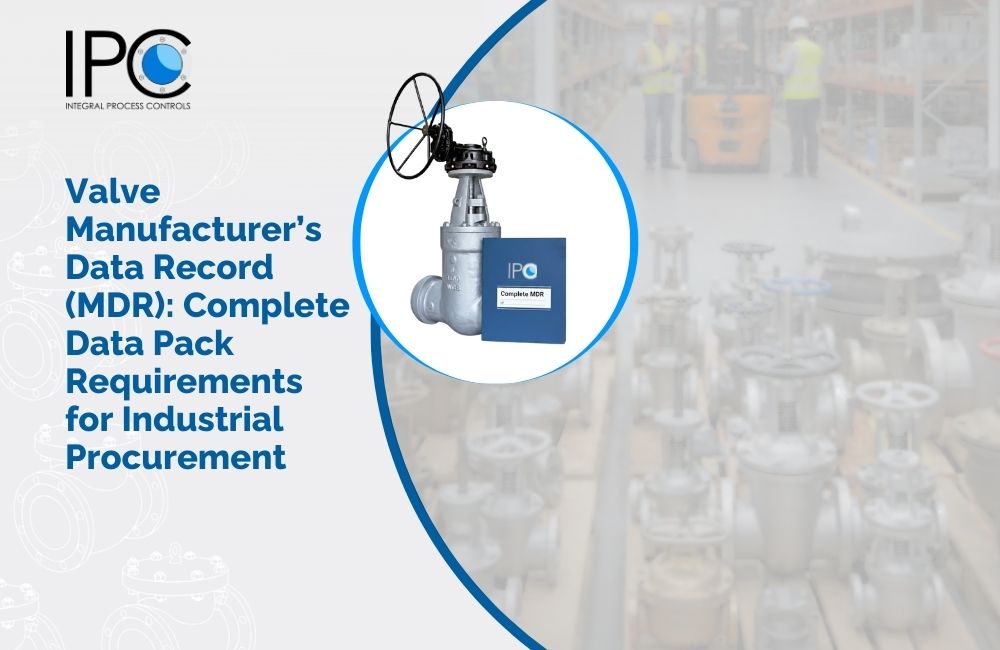
Why Your Valve’s Paperwork Matters as Much as the Valve Itself
In industrial procurement, the final product delivered to site is only half the story. The Manufacturer’s Data Record (MDR), often called the data pack, is the other half. For project engineers, quality inspectors and plant maintenance teams, a comprehensive MDR isn’t just paperwork it’s the DNA of your asset, proving its quality, safety and compliance from raw material to final test.
An incomplete or poorly organized data pack can stall project audits, delay system commissioning, and create future maintenance nightmares. At IPC, with our extensive experience supplying critical valves to the power, oil & gas and chemical sectors, we’ve built our documentation process to be a benchmark for clarity and completeness. This guide walks you through what a best-in-class MDR contains and why it makes procurement and project execution smoother.
Beyond the Invoice: The Anatomy of a Complete MDR/Data Pack
1. Foundational Documents: The “Birth Certificate”
Material Test Certificates (MTCs)/Mill Certificates: These are non-negotiable. They provide chemical and mechanical analysis for all primary wetted components—body, bonnet, trim, and bolting linking the material to a specific heat or melt number. This is the start of traceability.
Certificates of Conformity (CoC) & Origin (CoO): The CoC affirms the product meets order specifications, while the CoO is often required for customs and trade compliance.
2. Fabrication & Quality Records: The “Build Log”
Weld Procedure Specifications (WPS) & Procedure Qualification Records (PQR): For weld-end valves or fabricated components, these documents prove that welding was performed by qualified personnel using qualified procedures per ASME Section IX.
Welder/Welding Operator Qualifications & NDE Logs: Lists certified personnel and details all Non-Destructive Examination (like radiography, dye penetrant testing) performed, with results and acceptance criteria.
Final Dimensional Inspection Reports: Confirms the valve’s physical dimensions match the purchase order and relevant standards.
3. Testing & Performance Proof: The “Report Card”
Hydrostatic Shell & Seat Leak Test Reports: The most critical test data. Documents the pressure, duration, and measurable leakage (if any) during factory acceptance testing. Proof the valve holds pressure and seals tightly.
Functional Test Reports (for actuated valves): Details cycle testing, torque/thrust verification, and setting of limit switches.
Factory Acceptance Test (FAT) & Site Acceptance Test (SAT) Protocols: Formal documents, often witnessed by the client, that outline the test procedures and record results. A structured FAT ensures quality is verified before shipping.
4. Logistics & Lifecycle Support
Packing Lists & Preservation Records: Details how the valve was cleaned, protected, and packed for shipment to prevent damage.
As-Built Drawings & Manuals: Final, stamped drawings that reflect the exact configuration of the shipped valve, along with installation, operation, and maintenance (IOM) manuals.
The Procurement Angle: How a Great Data Pack Saves Time & Money
Why should procurement specialists care? Because a complete MDR directly impacts key performance indicators:
Ensures OTIF Delivery (On-Time, In-Full, with Documentation): A valve arriving without its data pack is essentially incomplete. It can’t be installed or accepted, disrupting the construction schedule. IPC’s integrated documentation process ensures the data pack is ready and shipped with the valve, supporting true OTIF delivery.
Streamlines Audits & Handovers: During project audits by clients or third-party inspectors, a well-indexed MDR allows for immediate verification of compliance. This speeds up approval cycles and final project handover.
Future-Proofs Maintenance & Recalls: Years later, if a specific material batch is recalled or a welding procedure needs review, a complete MDR allows you to instantly trace which assets in your plant are affected. This is critical for asset integrity management.
Reduces Supplier Risk: A manufacturer that consistently delivers perfect MDRs demonstrates a mature, controlled quality management system. It signals reliability for the long term.
The IPC Difference: Data Pack as a Deliverable, Not an Afterthought
At IPC, we treat the data pack with the same engineering rigor as the valve itself. Our systematic approach is built on the infrastructure highlighted on our website: a 25,000+ sq.ft manufacturing facility with in-house testing capabilities, overseen by 120+ industry experts. This control allows us to generate and collate all required documentation seamlessly throughout the production process.
We understand that our role extends beyond manufacturing; we are partners in your project’s success. By providing a transparent, auditable, and complete MDR, we don’t just deliver a valve we deliver confidence, compliance, and a tool for the entire lifecycle of your asset.
Conclusion:
Specifying a valve should always include specifying the data pack. A comprehensive Manufacturer’s Data Record is the ultimate mark of a quality-conscious supplier. It transforms a simple procurement transaction into a documented chain of custody that ensures quality, enables smooth project
execution, and provides invaluable data for the decades-long service life of your equipment. Demand documentation that meets the standard of the product itself.