


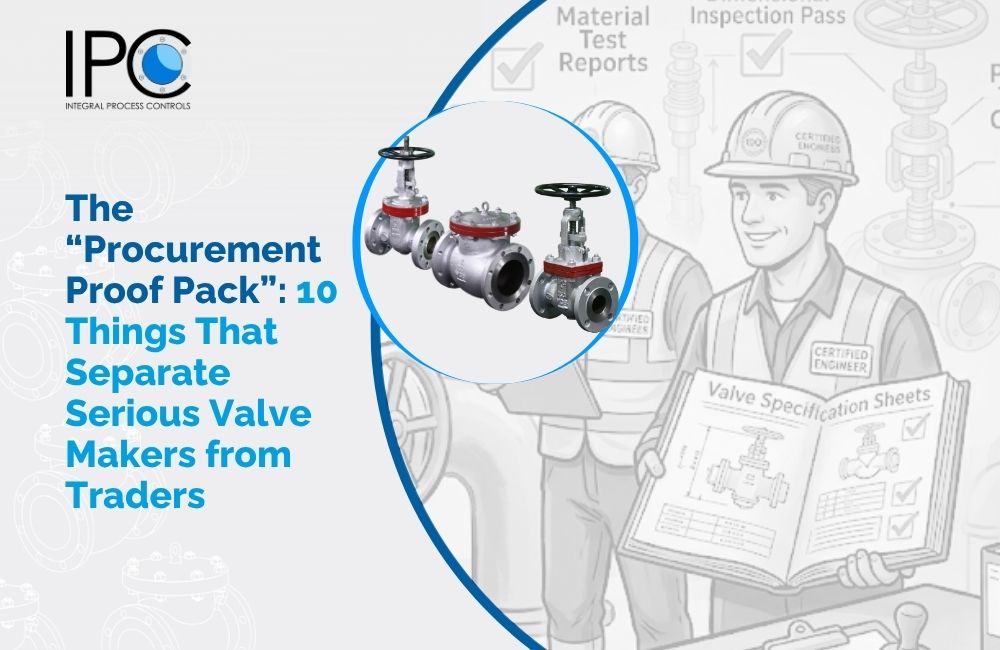
You’ve compared prices. You’ve checked delivery dates. You’ve even looked at the brand name on the casting. But there is one thing that separates a real, traceable industrial valve from a nameless piece of metal: the documentation that proves what is inside.
A valve from a trader often arrives with nothing more than a commercial invoice and a vague “test certificate” copied from the internet. A valve from a serious manufacturer like IPC valves arrives with a complete Procurement Proof Pack a structured set of documents that proves material origin, manufacturing quality, testing results and regulatory compliance.
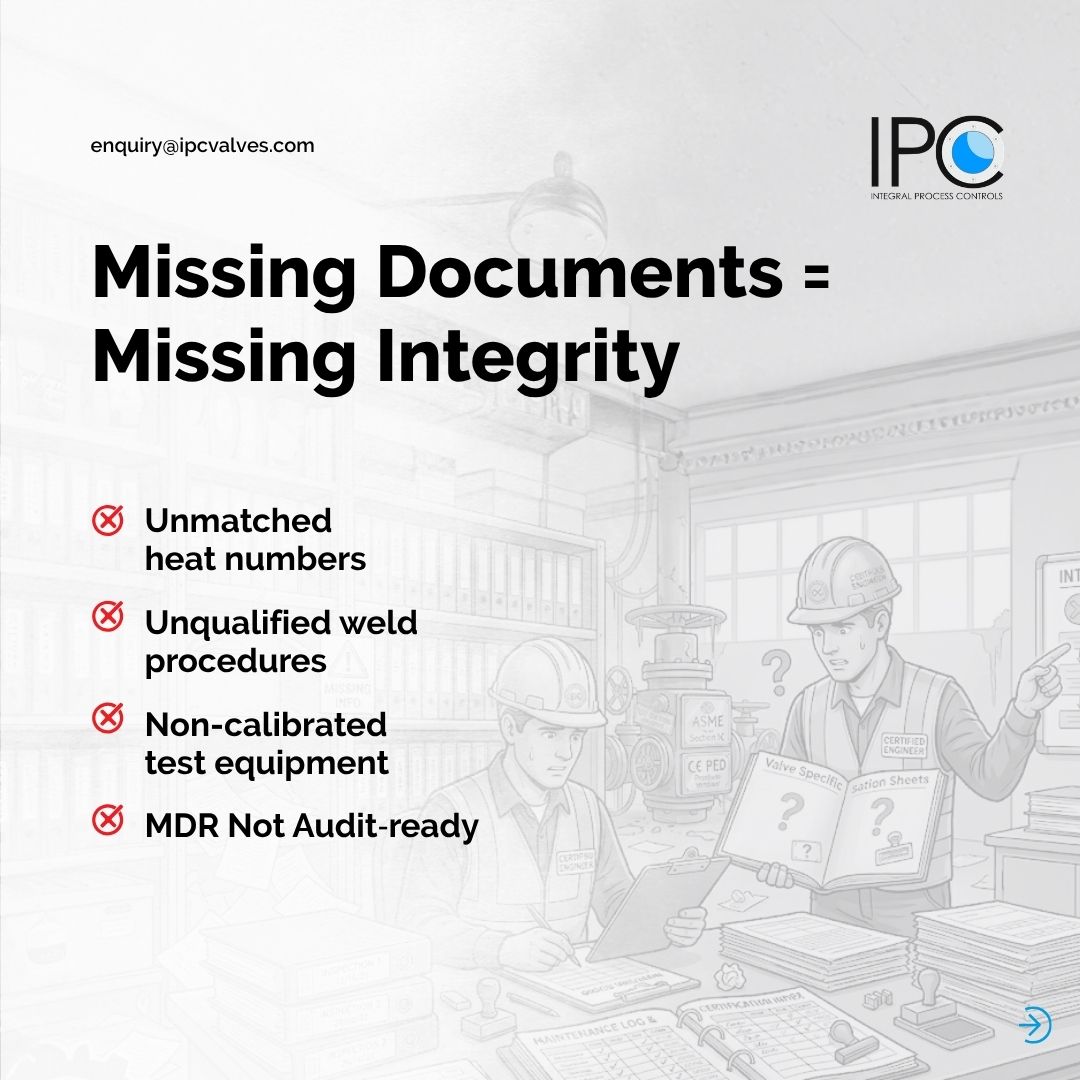
Why does this matter? Because without full traceability, you cannot:
- Pass a client or regulatory audit.
- Prove the valve is suitable for hazardous service ( fire-safe, high pressure).
- Ever replace a failed part with confidence.
- Avoid being liable when a leak or rupture occurs.
IPC has listed 10 critical documents that separate real valve makers from traders.
1. Material Test Certificates (MTCs) – The DNA of the Valve
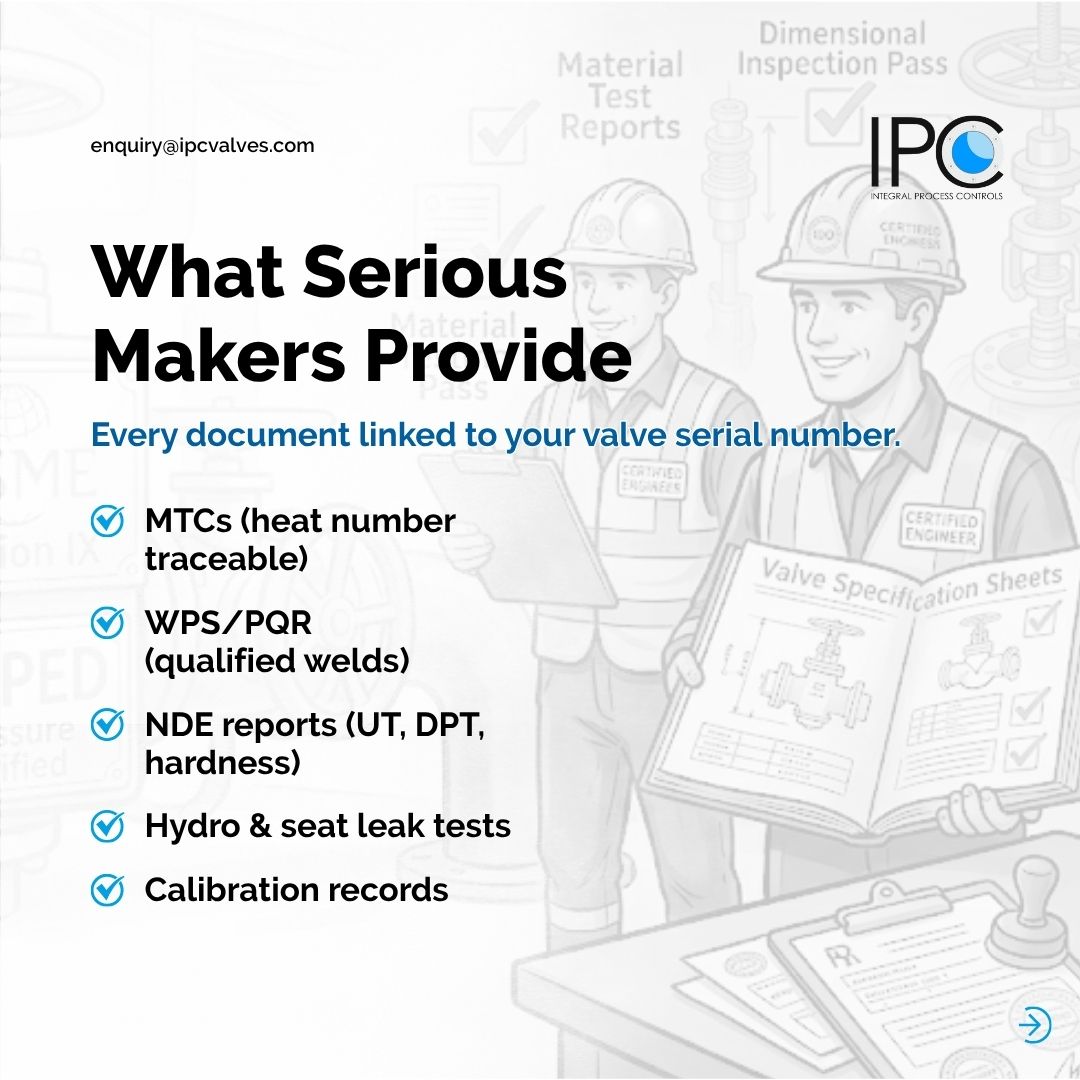
What it proves: Chemical composition and mechanical properties of every pressure‑containing part (body, bonnet, stem, disc, seat rings). Each MTC is linked to a specific heat number cast or stamped onto the part.
Trader’s shortcut: “We can provide MTCs from our stock.” But the numbers never match the valve markings.
IPC’s approach: Every IPC valve has traceable MTCs for all wetted components and the heat number is physically marked on the part. No mismatch, no excuse.
2. Welding Procedure Specifications (WPS) & Procedure Qualification Records (PQR)
What it proves: That every weld on a valve (e.g., seat hard‑facing, body repair, weld‑end attachment) was done using a qualified procedure per ASME Section IX.
Trader’s shortcut: “Our welders are certified.” But no documented WPS/PQR? That’s a code violation.
IPC’s approach: We maintain a full library of WPS/PQRs for each material and weld type. Each valve’s weld log references the applicable WPS.
3. Welder Performance Qualification (WPQ) Records
What it proves: The individual welder who worked on your valve is qualified for that specific welding process and material.
Trader’s shortcut: “We trust our workshop.” No written qualification no proof.
IPC’s approach: Every welder’s WPQ is on file, and each weld on your valve is traceable to the welder’s stamp.
4. Non Destructive Examination (NDE) Reports
What it proves: That critical areas (weld joints, castings, high‑stress zones) have been inspected for internal or surface defects using UT, DPT, or etc.
Trader’s shortcut: “We visually inspected it.” Visual inspection cannot find subsurface cracks.
IPC’s approach: We provide NDE logs showing test method, acceptance criteria, results, and inspector signature – for every required location.
5. Hydrostatic Shell & Seat Leak Test Reports
What it proves: The valve body and bonnet joint withstood 1.5x rated pressure (shell test), and the seat seals within allowed leakage limits (seat test) per API 598 or ISO 5208.
Trader’s shortcut: A generic “test certificate” with no test pressure, duration, or actual leakage measurement.
IPC’s approach: Each test report includes:
- Test pressure (measured with calibrated gauge)
- Hold time
- Observed leakage (in ml/min or bubble count)
- Tester name and date
- Valve serial number
6. Calibration Records for Testing Equipment
What it proves: That the pressure gauges, torque wrenches, and electronic testers used to verify your valve were calibrated against national standards within a valid time window.
Trader’s shortcut: No calibration records meaning the “test” could be wildly inaccurate.
IPC’s approach: We maintain calibration logs for all critical test equipment, and we include a summary of valid calibration dates with your MDR.
7. General Arrangement (GA) Drawings & As Built Dimensions
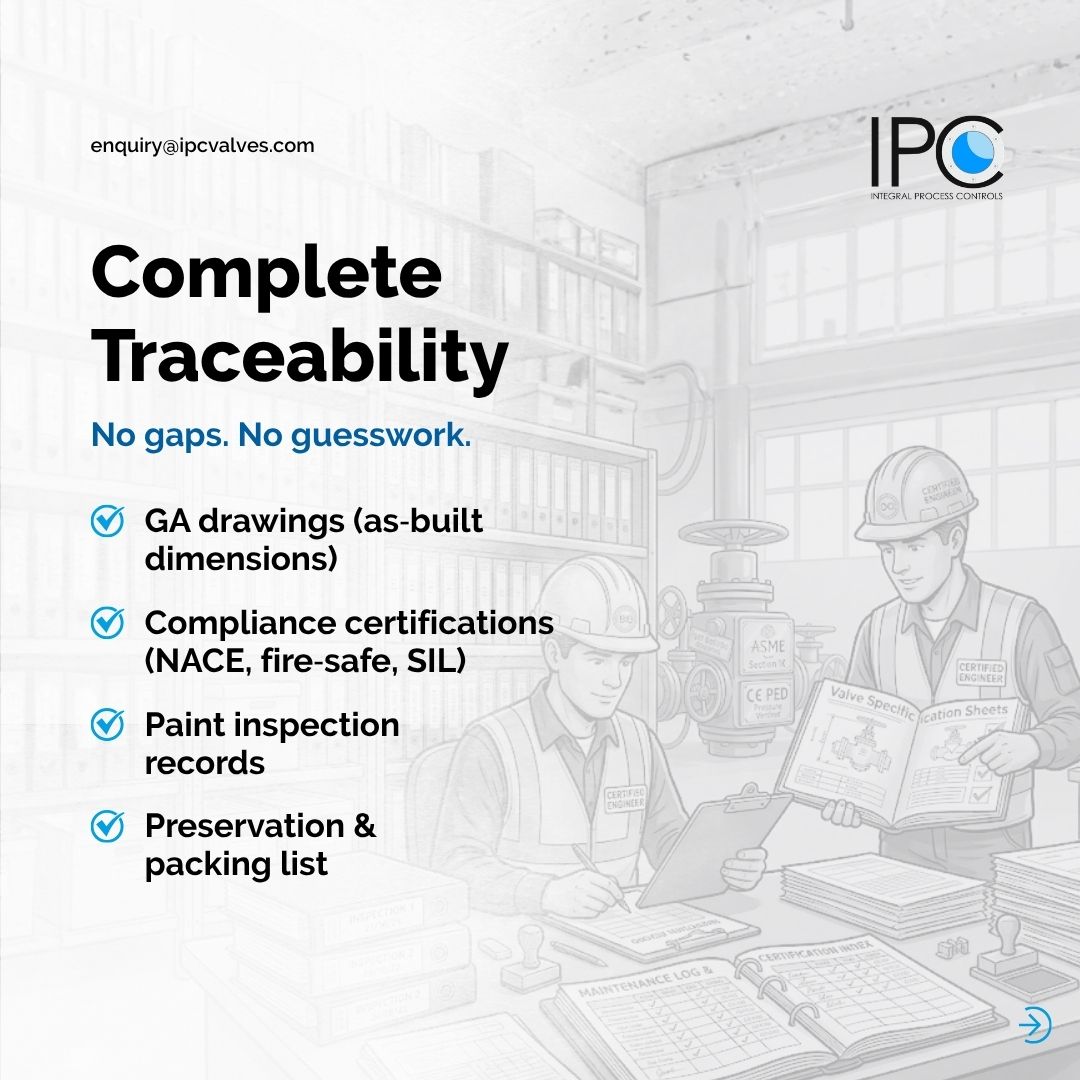
What it proves: The valve you received matches the dimensional specification in your purchase order – face‑to‑face, flange drilling, overall height, and actuator interface.
Trader’s shortcut: “It’s standard.” But no drawing, no verification.
IPC’s approach: We provide a certified GA drawing with your valve, including a dimensional inspection report signed by QA.
8. Compliance Certificates (NACE, Fire Safe, SIL, PED, ATEX, etc.)
What it proves: The valve meets the specific mandatory standard for your service – e.g., NACE ISO 15156 for sour service, API 607 for fire‑safe, SIL 3 for safety functions.
Trader’s shortcut: “We can supply a certificate from our supplier.” But the certificate is generic, not linked to your valve serial number.
IPC’s approach: Each compliance certificate is valve‑specific, with the serial number and test witness references.
9. Paint & Coating Inspection Reports
What it proves: The external coating thickness, adhesion, and curing were performed to your specification (e.g., epoxy, zinc primer, topcoat color).
Trader’s shortcut: No coating records meaning you could get rust in six months.
IPC’s approach: We document dry film thickness (DFT), salt contamination level (before coating), and visual inspection results.
10. Final Packing List & Preservation Record
What it proves: The valve was cleaned, protected (desiccant, flange covers, rust preventive), and packed to survive shipping and storage.
Trader’s shortcut: Valve thrown in a cardboard box with no protection.
IPC’s approach: We provide a preservation record and a detailed packing list – including photos of the valve before and after packing.
What a Trader Cannot Give You
- A complete Manufacturer’s Data Record (MDR)with all 10 documents linked to a single serial number.
- Traceabilityfrom raw material heat number to final test report.
- Audit‑readydocumentation that satisfies ISO 9001, client QA/QC, and third‑party inspectors.
Traders sell valves. Serious manufacturers prove them.
The IPC Uniqueness: Complete MDR Documentation Support
At IPC, we treat the documentation with the same rigor as the valve itself. Our 25,000+ sq. ft. facility and 120+ industry experts ensure that every Gate, Globe, Check, and ball valve ships with a complete, traceable, audit‑proof Procurement Pack.
We don’t just say “we have quality.” We show it with MTCs, WPS/PQR, NDE reports, hydro tests, calibration records, GA drawings, and compliance certificates.
Stop guessing whether your valve supplier can back up their claims. Request IPC’s sample procurement proof pack from a completed industrial valve project – redacted for confidentiality, but fully representative of what you will receive with every IPC valve.
Contact IPC Valves today or mail us evalve@ipcvalves.com and ask for the “Procurement Proof Pack”.