


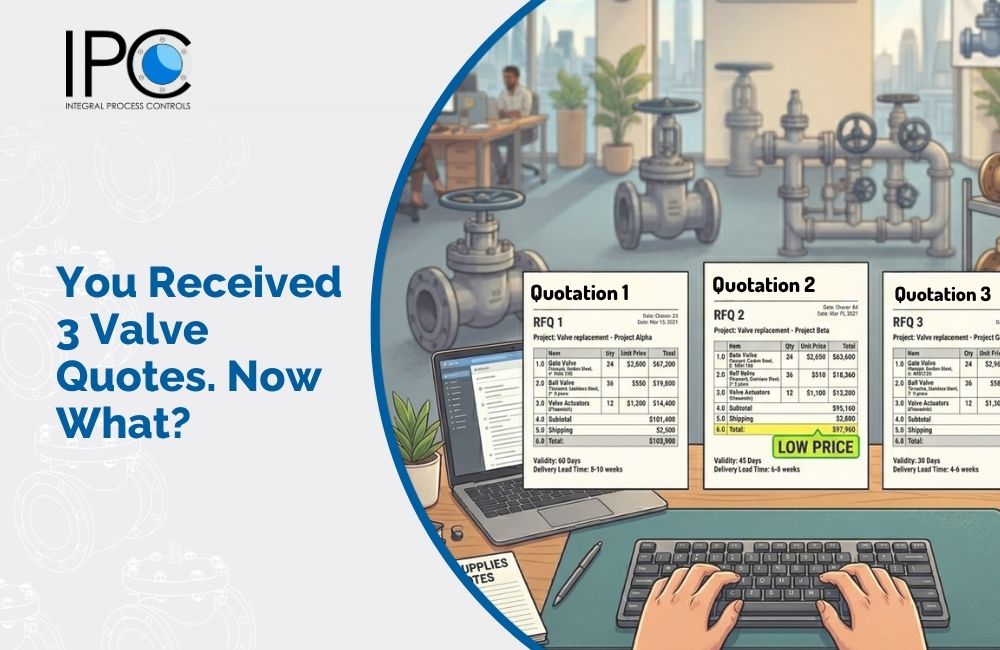
Three quotes are on your desk.
One is 15% cheaper.
One looks standard.
One has more details and documents attached.
The easy choice is the cheapest one.
But in industrial valves, the cheapest quote can sometimes become the most expensive decision.
A missing test report can delay approval.
A wrong material can fail in service.
A vague warranty can create arguments later.
A valve without spares can stop a plant for days.
So the real question is not, “Which quote is lowest?”
The real question is, “Which quote carries the least risk over the life of the valve?”
That is where a proper line-by-line comparison helps.
Start with the valve specification
Before looking at price, check whether all vendors have quoted the same valve.
Is the valve type correct?
Is the pressure class the same?
Is the body material as specified?
Are end connections, trim, actuation, accessories, painting, and testing included?
Sometimes a lower price comes because something has quietly changed. A material grade may be different. A coating may be skipped. A required accessory may be excluded.
At IPC, we quote as per the given specification. If there is any deviation, we highlight it clearly for your approval. That way, you don’t discover the gap after placing the PO.
Check the proof, not just the promise
A valve is proven by testing and documentation.
Ask for hydro test reports. Seat leak test reports. Material Test Certificates. Calibration records. Inspection reports. Dimensional checks. If the valve is for a regulated application, ask for the required certification and compliance documents.
A quote that says “reports available on request” should make you pause. In many cases, it means documentation is not ready, not structured, or not linked properly to that valve.
IPC supplies valves with a complete Manufacturer’s Data Record, where documents are linked to the valve serial number. This makes audits, handovers, and future maintenance easier.
Read the warranty properly
Check what is covered. Check what is excluded. Check the duration. Check the process to raise a claim.
A very attractive warranty can sometimes hide difficult exclusions. So compare the warranty terms, not just the warranty line.
IPC offers a clear and fair warranty against manufacturing defects. More importantly, we stand by it with a practical, responsive approach.
Chatter: Chatter is almost always a sizing and selection problem:
- Valve is oversized for the normal flow rate – the disc “hovers” near closed, fluttering open and shut.
- Pulsating flow(e.g., reciprocating pumps, compressors) – disc responds to each pulse.
- Low differential pressure – insufficient force to hold disc fully open.
Both slamming and chatter cause cyclic fatigue of the hinge, spring, and seat, leading to premature failure.
Look at spares before you need them
A valve may run for years. But packing, gaskets, fasteners, seats, and other parts may need attention over time.
So ask every vendor:
Can you give a recommended spares list?
Are common spares available?
What is the lead time?
Will part identification be easy later?
A valve without spares support becomes a risk after the first maintenance event.
IPC includes recommended spares wherever required and supports customers with traceable part details. This helps plants reduce downtime and plan maintenance better.
Compare delivery honestly
Late delivery can cost more than the valve itself.
Check whether the quoted lead time is realistic. Check packing and preservation. Check shipping documents. Check who takes responsibility under the selected delivery terms.
An impossibly short delivery promise may look good during negotiation, but it can hurt the project later.
IPC gives practical timelines and keeps communication open. If a project has a critical schedule, we help customers plan better from the RFQ stage itself.
The better buying decision
A good valve quote is not just a price sheet.
It is a complete offer.
It tells you what is included.
It proves how the valve will be tested.
It shows what documents you will receive.
It tells you how support will work after dispatch.
So when three quotes arrive, don’t compare only the final number. Compare the risk behind the number.
Still confused? Let IPC help you compare
Before you place the order, share your competing quotes with IPC.
We can help you review the technical scope, identify missing items, check documentation gaps, compare warranty and spares support, and build a clearer side-by-side view.
Because the goal is not to buy the cheapest valve.
The goal is to buy the right valve, with the lowest total cost of ownership.
Send your valve RFQ or comparison sheet to IPC. Let’s make your next valve purchase a smart one.