


Introduction: The One-Size-Fits-All Myth
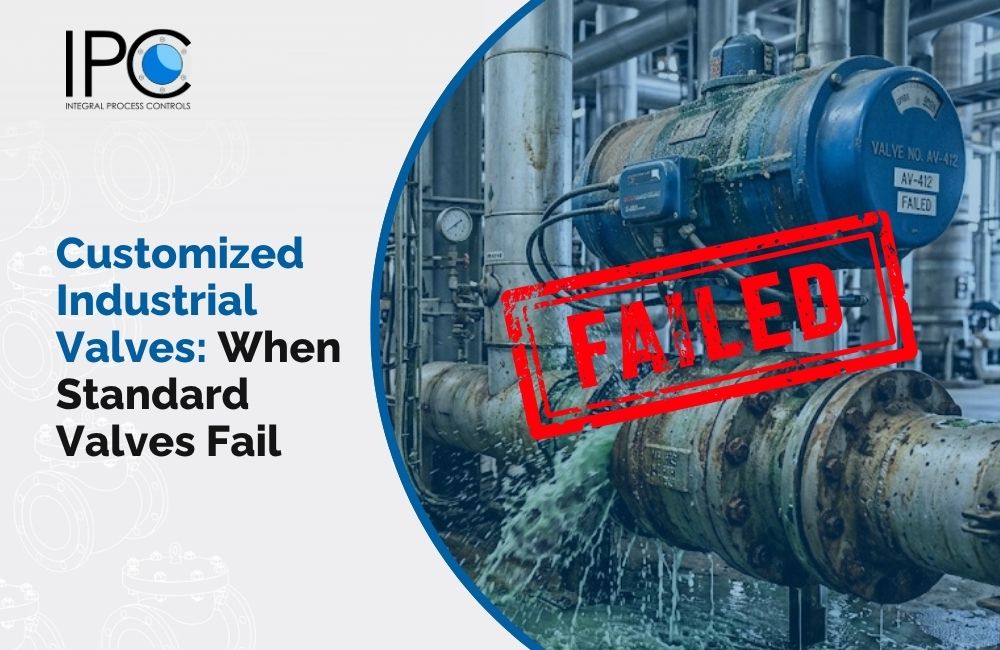
Standard valves are designed for average conditions average pressure, average temperature, average fluid. But your plant isn’t average. When you operate at extreme temperatures, handle abrasive slurries, or need precise actuation in tight spaces, standard valves fail. The result? Leaks, downtime, and costly repairs.
This guide shows you how to recognise when you need a customised industrial valve, what you can modify, and how to write a specification that delivers a right-fit solution.
1. Signals You Need Customisation (Not a Catalog Valve)
| Symptom | What It Means | Why Standard Fails |
| Frequent seat leakage | Fluid is more erosive/corrosive than expected. | Standard trim material can’t handle the service. |
| Packing leaks within months | Temperature or cycle rate is higher than standard packing can handle. | Off-the-shelf packing lacks the right thermal/mechanical rating. |
| Valve won’t fit the piping | Space constraints (short spool piece, odd flange orientation). | Standard face‑to‑face dimensions are too long/too short. |
| Actuator stalls or overshoots | Torque/thrust requirements differ from standard sizing. | Actuator not matched to your actual pressure/temperature profile. |
| Process upsets cause damage | Pressure spikes or thermal shocks exceed valve rating. | Standard pressure‑temperature rating isn’t designed for cyclical upsets. |
| Maintenance is difficult | Stem extensions or special access needed. | Standard bonnet height doesn’t allow for insulation or access. |
Takeaway: If you’ve replaced the same valve type three times in two years, you don’t need another standard valve you need a customised solution.
2. What to Modify (The Customisation Toolkit)
| Component | What You Can Change | When to Change It |
| Trim (seat, disc, stem) | Material (Stellite, Tungsten Carbide, 316L, Monel), hard‑facing, surface finish. | Erosive/corrosive fluids, high temperature, frequent cycling. |
| End Connections | Flanged (RF, RTJ), butt‑weld, socket‑weld, special facing (e.g., raised face, ring joint). | Piping code requirements, space constraints, leak‑tightness needs. |
| Bonnet / Stem Extension | length of bonnet for insulation, low temperature service or high‑temperature access. | Hot/cold piping with thick insulation, or valves in vaults/hard‑to‑reach areas. |
| Actuation & Accessories | Type (pneumatic, electric, hydraulic), fail‑safe action (spring‑return, double‑acting), positioner, solenoid, limit switches. | Automation requirements, safety (fail‑open/closed), control precision. |
| Body Material | Carbon steel, stainless, duplex, superalloys (Hastelloy, Inconel), lined (PTFE, PFA). | Corrosive fluids, high chloride, sour service, high temperature. |
| Special Coatings / Linings | Internal lining (PFA/ Ceramic/Glass), external coating (epoxy/ zinc/ host of other options). | Abrasive fluids, chemical resistance, atmospheric corrosion. |
IPC’s approach: We don’t just “customise” we engineer the modification to ensure it doesn’t compromise the valve’s integrity. Our engineering team validates each change with calculations and, if needed, prototype testing.
3. How to Write a Specification for a Customised Valve
A vague spec leads to a vague solution. Be precise:
Step 1: Define the Service Conditions
- Fluid: Name, composition, impurities (e.g., chlorides, H₂S, solids).
- Temperature: Normal, maximum, minimum, and expected ramp rates.
- Pressure: Normal, maximum, and any surge/spike conditions.
- Flow rate: Normal, maximum, minimum (for sizing).
- Cycle frequency: How many operations per day/hour?
Step 2: State the Required Valve Characteristics
- Valve type (gate, globe, ball, check justify why).
- Size & pressure class (e.g., 6″, Class 1500).
- End connections (type, facing, drilling).
- Body & trim material (specify exact ASTM grade, not just “stainless”).
- Packing – Graphite, PTFE (state temperature limits).
- Actuation type & fail‑safe action.
- Special requirements: NACE, fire‑safe, fugitive emission, SIL, cryogenic service.
Step 3: Include Testing & Documentation Requirements
- Testing: Hydrostatic, seat leakage, fugitive emission, fire‑safe—with acceptance criteria.
- NDE: Specify UT, DPT, or Radiography etc —and specific critical locations.
- Documentation: MTCs, WPS/PQR, NDE reports, test certificates—all linked to serial numbers.
Step 4: Review the Supplier’s Proposed Solution
- Ask for a dimensional drawing of the customised assembly.
- Request a material traceability plan how will they ensure heat numbers are tracked?
- Get a test plan what tests will be performed, and will they be witnessed?
IPC’s advantage: We can provide a detailed design review with every customised valve—showing exactly how we’ve addressed your specific requirements before we start manufacturing.
4. Results: What You Get with a Customised Valve
| Benefit | Why It Matters |
| Right fit | Valve fits your piping, actuator suits your control system, no field modifications. |
| Reduced leaks | Trim and packing matched to fluid and temperature, hence fewer fugitive emissions. |
| Less damage | Materials designed for your corrosion/erosion profile ensure longer life. |
| Smoother commissioning | Complete documentation and tested assembly ensure that there are no surprises during startup. |
| Lower LCC (life Cycle Cost) | Fewer failures, less maintenance, less downtime ensure that your LCC improves. |
5. IPC’s Customisation Process – Step by Step
- Requirements capture – We ask detailed questions about your service, piping layout, and automation needs.
- Design review – Our engineers propose modifications and validate them against standards.
- Manufacturing – We machine, weld, assemble, and test in our 25,000+ sq. ft. facility.
- Documentation – We provide a complete MDR with every customised valve.
- Delivery & support – We provide installation guidance and after‑sales support.
Conclusion: Stop Forcing Standard Valves Into Non‑Standard Jobs
If your service conditions are outside the ‘average’ standard valves will fail and you’ll pay for it in downtime, spares, and lost production. The solution is not to buy more of the same, but to specify a valve that fits your actual duty.
At IPC, we’ve been designing customised valves for over 20 years for power, oil & gas, chemicals, and pharmaceuticals. We know how to modify trim, ends, extensions, and actuation to match your needs.
Ready for a right‑fit valve? Send your service conditions to IPC we’ll propose a customised solution with documented engineering validation.