


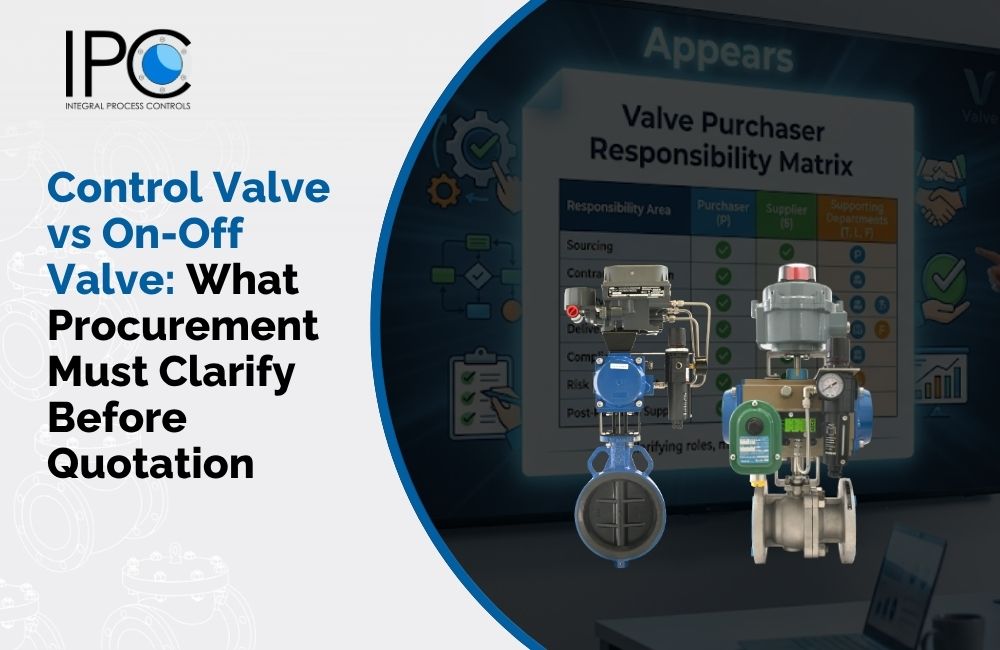
A procurement team sends an RFQ that says, “Actuated valve required.” One supplier quotes a pneumatic control valve with a positioner. Another quotes an on off valve with a solenoid and limit switches. Both offers may look automated. They are not necessarily comparable.
That is why the control valve vs on off valve decision must be clarified before quotation, not after technical deviations appear.
Start With Process Duty, Not the Actuator
A control valve is selected to modulate a process variable. It may continuously regulate flow, pressure, temperature or level across an operating range.
An on off valve is normally selected for a discrete action. It opens fully, closes fully, or moves between defined states for isolation, sequencing or shutdown.
An actuator adds movement. It does not automatically make an isolation valve suitable for control duty.
Five RFQ Questions That Prevent Mismatched Offers
- What must the valve do?
State whether the duty is modulating, isolation, batch sequencing, emergency shutdown or another defined action. Include the required control range and expected cycling. - What process data is available?
Control valve sizing needs minimum, normal and maximum flow, inlet/outlet pressure, temperature, media characteristics and expected differential pressure. Without these, quotations can be based on assumptions. - How must the valve shut and fail?
Specify shut-off expectation, leakage requirement, fail-open/fail-close/fail-in-place requirement and any response-time expectation. - What must the automation package include?
Define pneumatic or electric actuation, solenoid valves, position feedback, limit switches, positioner requirements and air-supply details where applicable. - Who owns the technical responsibility?
State who will confirm sizing, actuator load, material and trim selection, noise/cavitation assessment and final package compatibility.
Make the Quotation Easier to Compare
A broad term such as “control valve” can bring technically different packages. The same is true for a pneumatic control valve. One offer may include sizing and a positioner. Another may only include an actuated body.
IPC can help clarify the duty early and coordinate the valve, actuator and accessory package as one scope. For relevant quarter-turn throttling duties, a V-port ball configuration can be assessed rather than treating a standard on off ball valve as a control solution.
A clean RFQ reduces clarification loops. More importantly, it allows procurement to compare like-for-like offers before cost, delivery and documentation are evaluated.