


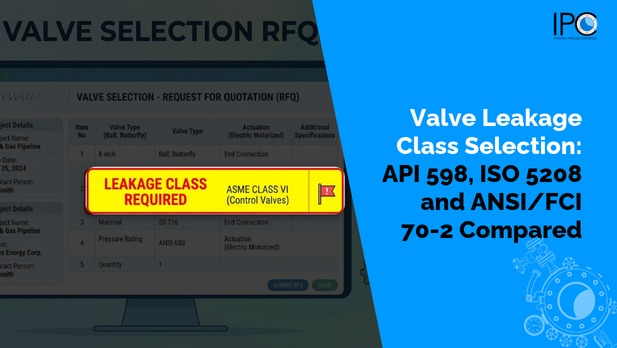
A valve RFQ that says “zero leakage” may sound clear. In practice, it can cause the opposite.
One supplier may quote a routine hydrostatic seat test. Another may interpret it as a soft-seat control-valve requirement. A third may flag it as unrealistic for a metal-seated severe-service valve. Before comparing prices, buyers need to compare the test method and acceptance rule.
Start With Shell Integrity vs Seat Shut-Off
A shell test checks whether the pressure-containing parts of a valve can withstand the stated test pressure. It covers the body, bonnet and pressure-retaining joints. It does not prove how tightly the valve closes.
A seat or closure test checks leakage across the closed seating surfaces. Both tests may be necessary. They simply answer different questions.
Where API 598, ISO 5208 and ANSI/FCI 70-2 Fit
API 598 is widely used for inspection and pressure testing of new industrial valves. It provides a familiar basis for shell and closure tests across many isolation-valve types. Its allowable closure leakage depends on the valve and seat category, plus the stated test condition.
ISO 5208 is a pressure-testing framework for metallic industrial valves. It includes named leakage-rate classifications. When asking for an ISO 5208 leakage rate, specify the exact rate in the RFQ. Do not assume it directly converts to an API 598 requirement.
ANSI/FCI 70-2 is normally the more relevant standard for control valve leakage class selection. It defines control-valve seat-leakage acceptance under stated test conditions. It should not be copied into every gate, ball, plug or check-valve RFQ without checking the applicable product standard and valve design.
Soft Seat vs Metal Seat Changes the Requirement
Soft seats can often support tighter factory closure where the process fluid, temperature and pressure allow it. Metal seats may need a defined allowable leakage rate, particularly in high-temperature, abrasive or severe-service duty.
“Bubble-tight” and “zero leakage” are not complete specifications by themselves. Test medium, pressure differential, duration and measurement method all matter. A water-test result cannot automatically be read as proof of equivalent gas-service shut-off.
Make the RFQ Testable
State the standard and edition, valve type, seat material, shell or seat-test requirement, medium, test pressure, duration, acceptance rate or class, closure direction where relevant, and required test report.
IPC can help interpret the project requirement before the order is released. This helps define practical acceptance criteria, align hydrostatic and seat testing, and include traceable test records in the MDR. Procurement then compares like-for-like offers—without paying for an irrelevant or impossible requirement.