


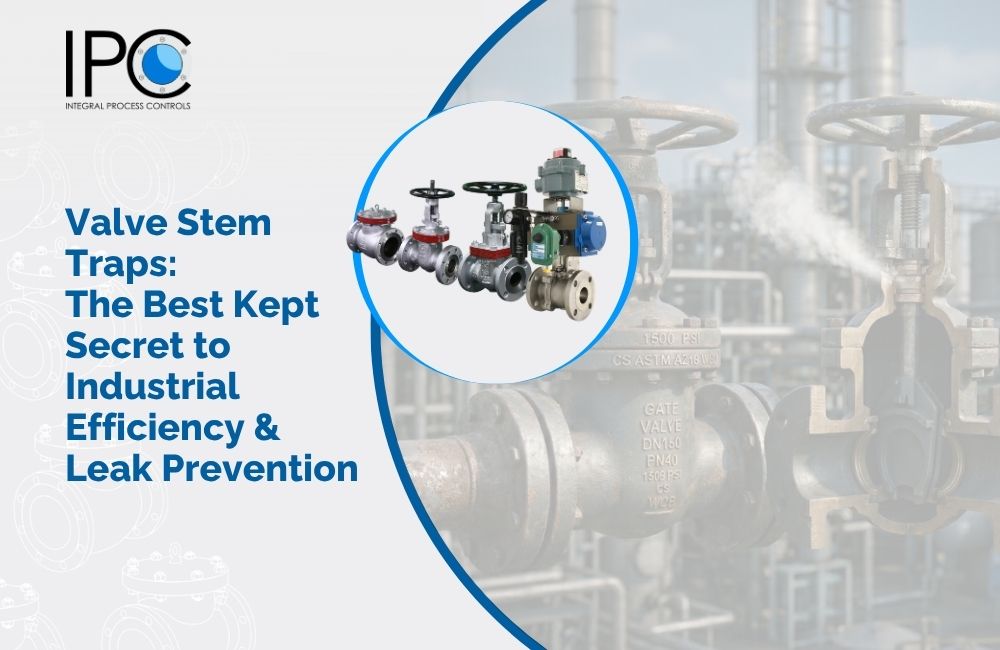
In most industrial facilities, the spotlight falls on pumps, compressors and boilers when production managers hunt for inefficiencies. The humble valve and more specifically, its stem rarely receives the scrutiny it deserves. Yet industry maintenance data consistently reveals that valve stem leakage is one of the top five contributors to energy loss, unplanned downtime and costly fugitive emissions in refineries, chemical plants, power stations and process industries worldwide.
At IPC Valves, we’ve spent decades engineering precision Gate Valves, Globe Valves and Ball Valves for demanding industrial applications. What we’ve learned and what most plant engineers don’t fully appreciate is that the valve stem functions as a natural ‘trap’ system. When properly designed and maintained, it traps pressure, blocks fugitive emissions, and prevents leakage. When neglected, it becomes the silent source of massive operational losses.
"A single valve stem leak in a high-pressure steam line can waste over tonnes of steam per year the equivalent of running a mid-sized industrial boiler completely unproductive for two full weeks."
What Exactly Is a Valve Stem and Why Does It Matter?
The valve stem is the mechanical link between the actuator or handwheel and the internal closure element of the valve be it a gate, globe disc, ball mechanism. As the stem moves, it drives the closure element to open, throttle or shut flow in a pipeline.
The stem passes through the valve body and must maintain a pressure-tight seal at the point of exit called the stuffing box or packing gland while still being able to move freely. This is where the engineering challenge lies. If the seal is too loose, you get industrial valve leakage. If it’s too tight, you get stem friction, increased torque and premature mechanical wear.
The packing inside this stuffing box is the first line of defence against fugitive emissions and external leaks. Common packing materials include PTFE (Teflon), graphite, braided asbestos-free fibre and expanded graphite composites each suited to specific temperature, pressure and chemical service conditions.
How Proper Valve Stem Design Prevents Losses
Think of a well-engineered valve stem assembly as a precision steam trap a device designed not to let what’s inside the pipe escape into the environment. Just as a steam trap allows condensate out while blocking live steam, a correctly packed and sealed valve stem allows mechanical motion while blocking process fluid, gas or steam from escaping.
This parallel is not just metaphorical. In facilities where steam is the process medium, valve stem packing integrity is directly tied to steam trap performance. A leaking valve stem on a globe valve controlling steam flow can introduce condensate-laden steam bypass around a well-functioning steam trap rendering the entire heat management system inefficient.
Key Valve Stem Design Features That Prevent Leakage
- Rising Stem Design: Rising stem with anti-rotation guides for consistent packing compression and even wear distribution across Gate Valves and Globe Valves.
- Packing Stack Configuration: The number of packing rings, their material grade and the gland follower material must be matched precisely to the process temperature, chemical media and operating pressure. A mismatch here is the single most common cause of premature valve stem seal failure.
- Stem Surface Finish: Precision-machined stems with fine surface finishes (Ra 0.4 µm or better) dramatically reduce friction and packing wear, extending service intervals significantly.
- Blow-Out Proof Stems: Blow-out proof stem designs mandatory in modern Ball Valves ensure that even under full upstream pressure, the stem cannot be ejected from the body in the event of a packing failure, preventing catastrophic industrial accidents.
- Live-Loaded Packing Systems: Live-loaded packing systems using disc spring washers maintain constant compression on the packing even as it wears or consolidates over time, significantly reducing the need for field adjustments.
High-Impact Areas: Where Valve Stem Integrity Is Critical
1. Refineries & Petrochemical Plants
2. Power Generation & Steam Systems
3. Chemical & Pharmaceutical Process Industries
In chemical processing, a leaking check valve or ball valve stem can mean product contamination, cross-process reactions, and regulatory non-compliance. In pharmaceutical manufacturing, even microscopic leakage paths are unacceptable. IPC Valves engineers valves with double-packing configurations for ultra-low leakage pharmaceutical and chemical applications.
Common Causes of Valve Stem Leakage and How to Fix Them
Understanding failure modes is essential to preventing them. Here are the most common causes of valve stem leakage encountered in industrial plants:
- Improper Packing Gland Torque: Over-tightening the packing gland causes stem friction, packing extrusion, and accelerated wear. Under-tightening allows immediate leakage. The correct approach is torque-controlled tightening to manufacturer specifications.
- Packing Material Degradation: All organic and semi-organic packing materials degrade over time especially when exposed to thermal cycling, chemical attack, or UV radiation. Scheduled packing inspection and replacement are essential for industrial valve maintenance.
- Stem Surface Corrosion or Damage: Stem surface damage from corrosion, pitting, or mechanical scoring creates leakage paths that no amount of packing adjustment can overcome. The stem must be replaced or re-machined.
- Misalignment: Misalignment between the stem, gland follower, and packing box due to improper installation or body distortion from pipeline stresses creates uneven sealing and leak paths.
- Wrong Packing Material for the Service: Incorrect packing material for the process medium for example, using PTFE packing on high-temperature steam service where it exceeds thermal limits results in rapid failure.
Pro Tip from IPC Valves: Always specify valve stem packing material based on the most extreme combination of temperature + pressure + chemical compatibility not just one factor in isolation.
The IPC Valves Advantage: Engineering Stems That Work as Traps
At IPC Valves, every valve we manufacture from our heavy-duty industrial Gate Valves to our precision Globe Valves, robust Check Valves, and high-cycle Ball Valves is engineered with stem integrity as a core design parameter, not an afterthought.
Our manufacturing facility uses CNC precision machining to achieve stem surface finishes that meet and exceed international standards. Our quality inspection process verifies packing gland dimensions, stem straightness, and surface finish on every unit before dispatch. We offer application-specific packing configurations including:
- Standard PTFE and graphite packing for general industrial service
- Live-loaded double packing for fugitive emission compliance
- High-temperature graphite packing for power plant and steam service
- PTFE V-ring packing for chemical-resistant applications in pharmaceutical and food-grade plants
Maintenance Best Practices for Valve Stem Longevity
Preventing valve stem leakage is far more cost-effective than dealing with its consequences. The following best practices align with international plant maintenance standards and IPC Valves’ field recommendations:
- Conduct routine packing gland inspection every 6 – 12 months or as part of scheduled plant turnarounds. Check for signs of weeping, crust formation, or visible packing extrusion.
- During each inspection, verify stem surface condition. Replace stems showing signs of pitting, corrosion, or scoring immediately.
- Apply appropriate stem lubricants compatible with the process medium to reduce friction and packing wear.
- When repacking valves, always use OEM-approved packing materials specified for the actual service conditions.
- Implement fugitive emission monitoring programmes using portable leak detectors to catch stem leaks before they become visible.
- Train maintenance technicians on correct packing gland torque procedures — this single step prevents the majority of post-maintenance leaks.
Why Valve Stem Health = Plant Efficiency
The connection between valve stem integrity and overall industrial plant efficiency is direct and quantifiable. Consider a mid-sized process plant with 500 control and isolation valves. Industry estimates suggest that 3–5% of these valves will have some degree of stem leakage at any given time that’s 15 to 25 leaking valves. Individually, each might seem minor. Cumulatively, the losses in steam, process fluid, product, and energy can run into millions of rupees annually.
Beyond direct energy and product losses, leaking valve stems create secondary costs: increased corrosion around the valve body, safety incidents, environmental violations, and unplanned maintenance interventions that disrupt production schedules.
A systematic approach to valve stem management correct specification at procurement, proper installation, regular inspection, and timely repacking delivers measurable returns on investment that plant engineers can demonstrate to management.
Conclusion: The Stem Is the Secret
The valve stem is not a glamorous component. It doesn’t appear on process flow diagrams. It rarely features in maintenance KPI dashboards. But it is, as experienced plant engineers know, the best-kept secret to industrial efficiency and leak prevention.
When IPC Valves designs a Gate Valve, Globe Valve, Check Valve, or Ball Valve, we think about the stem from the first line of the design drawing to the final quality inspection. Because we understand that the stem is not just a piece of metal connecting a handwheel to a disc, it is the guardian of process integrity, the silent trap that keeps valuable process media inside the pipe where it belongs.
Ready to upgrade your valve specification with stem integrity as a priority? Contact IPC Valves at www.ipcvalves.com or mail us at enquiry@ipcvalves.com Precision Valves. Proven Performance.