


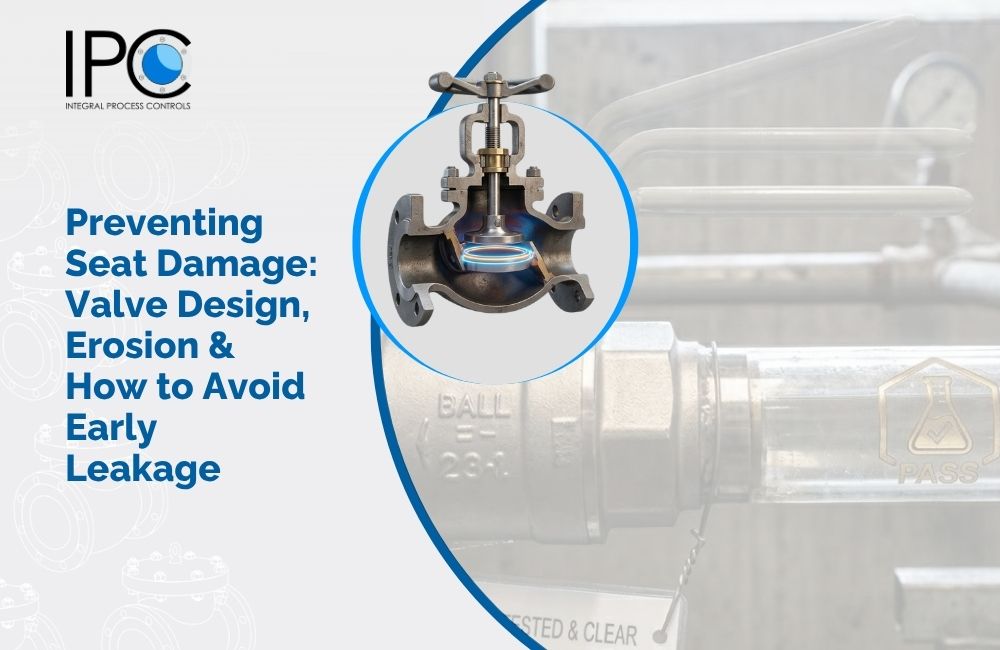
Introduction: The High Cost of a Failed Seat
In the world of industrial valves, the seat is where the magic happens. It’s the precision interface that creates a bubble-tight shutoff, isolates process fluids, and ensures system integrity. But it’s also the component most vulnerable to damage. When valve seat failure occurs, the result is immediate: leakage past the closed valve, loss of system control, and often an unplanned shutdown.
The primary culprit? Valve seat erosion. High-velocity flow, entrained particles, flashing fluids, and cavitation can slowly or sometimes rapidly destroy seating surfaces, turning a perfectly good valve into a liability.
At IPC, with over 25 years of experience serving critical industries like power fertiliser, steel, generation, oil and gas, chemical processing, and refining, we’ve seen every variation of seat damage. More importantly, we’ve engineered solutions to prevent it. This guide explains how valve design choices, material selection, and operational practices can dramatically extend seat life and prevent early leakage.
Understanding Valve Seat Failure
What Actually Happens When a Seat Fails?
| Failure Mode | Description | Typical Causes |
| Erosion | Gradual removal of seat material by flowing media | High velocity, suspended solids, flashing |
| Corrosion | Chemical attack on seat materials | Incompatible materials, aggressive fluids |
| Galling | Material transfer between seat and abturator in plant disc | Similar materials, high contact stress |
| Deformation | Permanent distortion of seat geometry | Over-torquing, thermal shock, pressure spikes |
| Embedment | Particles pressed into soft seat materials | Debris in system, dirty fluids |
The Erosion Problem
Particle impact: Solids in the fluid strike the seat surface, gradually wearing it away.
Flashing: When liquid flashes to vapor across a seat, the expanding bubbles create high-velocity droplets that erode surfaces.
Cavitation: Bubble collapse near surfaces generates micro-jets that can erode even hard materials.
Wire drawing: Small leaks through a partially closed seat create high-velocity fluid jets that cut through metal like a knife.
Valve Design Features That Prevent Seat Damage
1. Hard-Facing: Armor for Seating Surfaces
| Material | Hardness (HRC) | Best For |
| Stellite 6 | 38-44 | General erosion resistance, high temperature |
| Stellite 21 | 28-35 | Impact resistance, thermal shock |
| Tungsten Carbide | 65-75 | Extreme abrasion, slurry service |
| Chrome Carbide | 55-65 | High-temperature wear |
Seat Geometry: Managing Flow Path
The shape of the seat affects how fluid flows through the valve during opening and closing. Design features that reduce erosion include:
- Streamlined flow paths: Minimize turbulence and flow separation.
- Extended seat protection: Some designs position the seat away from the highest velocity zones during partial opening.
- Sacrificial trim elements: Replaceable components that take the brunt of erosive service.
Soft Seats vs. Metal Seats: The Trade-Off
| Seat Type | Advantages | Erosion Risk |
| Soft Seat (PTFE, PEEK, Nylon | Bubble-tight shutoff, low torque | High easily damaged by particles or high velocity |
| Metal Seat | Excellent erosion resistance, high temperature | Moderate—can achieve tight shutoff with precision finishing |
Operational Practices That Extend Seat Life
1. Avoid Partially Open Operation for Isolation Valves
Gate valves, ball valves, and butterfly valves are designed to be either fully open or fully closed. Operating them partially open:
- Exposes seats to high-velocity flow.
- Creates wire drawing if the valve isn’t designed for throttling.
- Accelerates erosion dramatically.
If you need throttling, specify a valve designed for it—like a globe valve with appropriate trim.
2. Clean Your Systems Before Startup
Construction debris, weld slag, and scale are seat destroyers. Before commissioning:
- Flush lines thoroughly.
- Consider temporary strainers during startup.
- Cycle valves slowly to clear debris without damaging seats.
3. Control Fluid Velocity
Excessive velocity is the enemy of seat life. Guidelines:
- Keep liquid velocities below 5 m/s for clean service, lower for solids.
- For gases, avoid sonic velocity across seats.
- Consider larger valves to reduce velocity if erosion is an issue.
4. Monitor and Trend Performance
5. Seat Leakage Testing
| Test Type | Method | Sensitivity |
| Hydrostatic</strong | Water pressure, visual check for leaks | Low |
| Pneumatic | Air pressure, bubble observation | Medium |
| Gas decay | Pressure drop over time | High |
| Helium mass spec | Tracer gas detection | Extremely high |
IPC's Approach to Seat Reliability
At IPC, we design valves with seat protection as a primary objective. Our gate, globe, check, and ball valves incorporate:
- Precision seat finishing to microscopic tolerances.
- Hard-facing options for erosive services.
- Material expertise from our 120+ industry experts.
- Application engineering to match seat design to your process.
- Full documentation of seat materials and test results.
Our 25,000+ sq. ft. manufacturing facility allows us to control every aspect of seat production, from raw material certification to final seat leakage testing.
Conclusion: Protect the Seat, Protect the System
Preventing valve seat damage isn’t complicated, but it requires attention to design, material selection, and operation. The seat is the heart of the valve’s shutoff capability—when it fails, the valve fails.
By understanding the mechanisms of valve seat erosion, specifying appropriate materials and designs, and following operational best practices, you can extend seat life dramatically and avoid the cost and disruption of early leakage.
Ready to specify valves with superior seat protection? Contact IPC’s technical team for guidance on seat materials, hard-facing options, and designs tailored to your specific process conditions.