


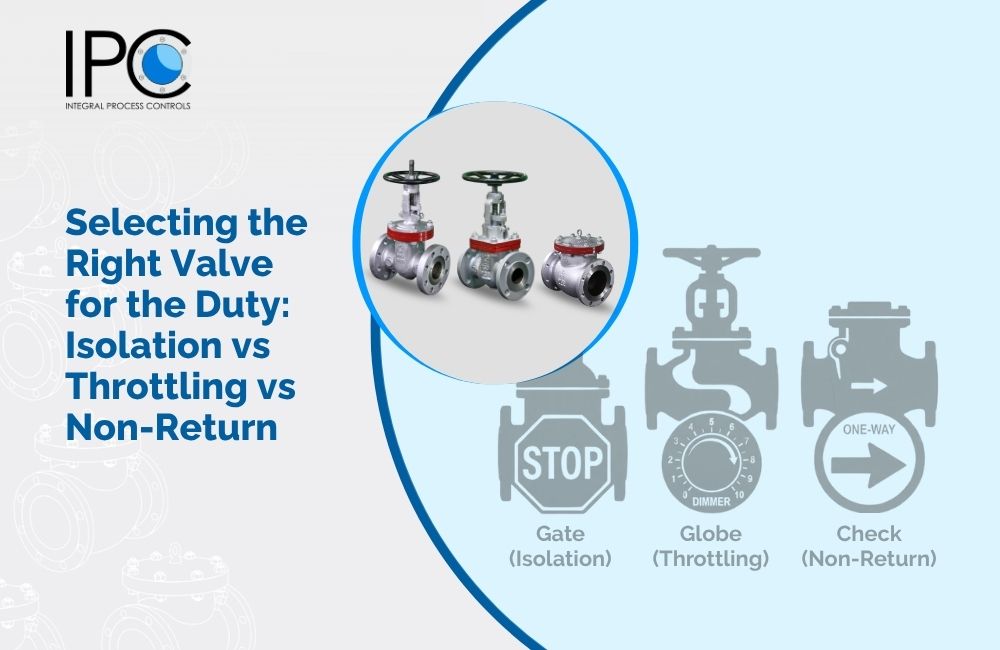
Walk through any industrial facility a refinery, a power plant, a chemical processing unit and you’ll see valves everywhere. Hundreds, sometimes thousands, each performing a specific job. But here’s the critical insight:
a valve that excels at one job can fail catastrophically at another.
Using a gate valve to throttle flow is like using a sledgehammer to drive a finishing nail. Using a globe valve for emergency isolation is like using a sports car to tow a trailer. It might work for a while, but it’s wrong for the job, and it will cost you in performance, maintenance, and reliability.
At IPC, with over 25 years of experience manufacturing of Gate, Globe, Check, and Ball Valves for industries like oil and gas, power generation, chemicals, steel sector, fertiliser and pharmaceuticals, we’ve learned that the first step to valve reliability is matching the valve type to its intended duty.
This guide explains valve classification based on function covering the three core roles valves perform: isolation, throttling and non-return so you can confidently choose the right valve for your application.
The Big Picture: Valve Classification by Function
| Classification Factor | Description | Examples/Types |
| Function | The valve’s intended operational role in controlling fluid flow | Isolation valves, non-return valves, throttling valves, final control elements |
| Motion | The physical movement of the valve’s closure element | Linear motion valves, rotary motion valves |
| Service | The environmental and operational conditions the valve is designed to handle | General service, special service, severe service |
Function 1: Isolation Valves (On-Off / Block Valves
| Valve Type | Motion | Best For | Limitations |
| Gate Valve | Linear | Fully open/closed service; low pressure drop; bi-directional | Not for throttling; slow operation |
| Ball Valve | Rotary | Quick operation; tight shutoff; bi-directional | Not for throttling (unless specially designed) |
| Butterfly Valve | Rotary | Large diameters; low cost; space-saving | May have higher pressure drop; limited pressure rating |
| Plug Valve | Rotary | Slurry service; Cavity free design | Higher torque than ball valves |
When to Use Isolation Valves
- Equipment isolation: Isolating pumps, heat exchangers, or vessels for maintenance.
- Section isolation: Dividing a process line into manageable sections.
- Emergency shutdown: Rapidly stopping flow in an emergency.
- Media diversion: Directing flow to different process path
The Golden Rule for Isolation Valves
Function 2: Throttling Valves (Regulating Valves)
Throttling valves are designed to do what isolation valves cannot: regulate flow, pressure, or temperature by varying the valve opening position continuously. They
operate anywhere between fully open and fully closed, maintaining precise control over process conditions.
Common Throttling Valve Types
| Valve Type | Motion | Best For | Limitation |
| Globe Valve | Linear | Precise flow control; high pressure drop capability | Higher pressure drop when open |
Automated Control Valve | Linear/Rotary | Automated process control; with positioner and actuator | More complex; higher cost |
| Needle Valve | Linear | Fine flow control; instrumentation | Small sizes only |
Eccentric Plug Valve | Rotary | Moderate throttling; slurry service | Less precise than globe valve |
V-port Ball Valve | Rotary | Throttling with ball valve benefits | Higher cost than standard ball valve |
Why Globe Valves Excel at Throttling
When to Use Throttling Valves
- Flow control: Maintaining a specific flow rate.
- Pressure regulation: Reducing or stabilizing downstream pressure.
- Temperature control: Regulating heat transfer by controlling flow.
- Level control: Maintaining tank or vessel levels.
- Bypass control: Routing flow around equipment during startup or shutdown.
The Golden Rule for Throttling Valves
Function 3: Non-Return Valves (Check Valves)
Non-return valves commonly called check valves have a single, simple job: allow flow in one direction only, preventing backflow that could damage equipment, reverse process flow, or create safety hazards. They operate automatically, without external actuation, using the flow itself to open and close.
Common Check Valve Types
| Valve Type | Motion | Best For | Limitation |
| Swing Check | Swing | Low velocity; clean fluids; horizontal piping | Can slam in vertical flow; slow closing |
| Lift Check | Linear | High pressure; globe valve style body | Higher pressure drop |
| Wafer Check | Swing | Compact spaces; quick closing | Not for pulsating flow |
Dual Plate (Tilting Disc) | Split Swing | Quick closing; low pressure drop | Complex internals |
| Ball Check | Linear | Slurry service; viscous fluids | Can be noisy |
When to Use Check Valves
- Pump protection: Preventing backflow when a pump stops.
- Parallel pump operation: Preventing reverse flow through idle pumps.
- Compressor discharge: Protecting compressors from reverse flow.
- Heat exchanger circuits: Maintaining proper flow direction.
- Any system where backflow could cause damage: Including mixing lines, header systems, and gravity drains.
Critical Considerations for Check Valves
Slam is the enemy of check valves. When flow reverses suddenly such as during a pump trip the closing disc can slam into its seat, creating a pressure surge (water hammer) that can damage piping, instruments, and the valve itself. Proper selection of check valve type and closing speed is essential.
Sizing matters: An oversized check valve may never fully open, causing the disc to “flutter,” leading to premature wear. An undersized check valve creates excessive pressure drop.
Service: Matching the Valve to the Environment
| Service Class | Description | Examples | Limitation |
| General Service | Non-corrosive fluids; moderate temperature and pressure | Water, air, light oil | Can slam in vertical flow; slow closing |
| Special Service | Corrosive, high-purity, or extreme temperatures | Chemicals, cryogenic, high-temp steam | Higher pressure drop |
| Severe Service | High pressure drop, erosive fluids, cavitation, flashing | Boiler feedwater, slurry, high-pressure letdown | Not for pulsating flow |
Valve Selection Decision Matrix
| Your Need | Consider This Valve Type | Why |
Start/stop flow (isolation) | Gate Valve | Low pressure drop when open; tight shutoff; bi-directional |
Quick isolation, frequent operation | Ball Valve | Quarter-turn operation; bubble-tight shutoff; compact |
| Large diameter, cost-sensitive | Butterfly Valve | Space-saving; lower cost; adequate for many services |
| Precise flow regulation | Globe Valve | Designed for throttling; fine control; stable at partial opening |
Automated process control | Control / Globe Valve | Positioner and actuator for precise, repeatable control |
| Prevent backflow | Check Valve | Automatic; no actuation needed; protects equipment |
Toxic or hazardous fluids | Bellows Seal Valve | Zero stem leakage; complete containment |
High pressure drop, severe service | Globe with multi-stage trim | Reduces erosion; prevents cavitation |
| Reduces erosion; prevents cavitation | knife gate valve | Minimal flow restriction; less clogging |
Common Mistakes in Valve Selection
1. Using a Gate Valve for Throttling
Gate valves are designed for fully open or fully closed service. Partially open:
- High-velocity flow erodes the seat.
- Disc can vibrate, causing damage.
- Sealing surfaces wear unevenly.
Result: The valve no longer seals when closed.
2. Using a Globe Valve for Isolation Without Verification
Some globe valves are rated for tight shutoff; many are not. If isolation is required:
- Verify the valve’s shutoff classification (Class IV, V, or VI per FCI 70-2).
- Consider a dedicated isolation valve upstream.
3. Oversizing a Check Valve
A check valve that’s too large for the flow may never fully open. The disc “flutters” in the flow stream, leading to:
- Premature wear on hinge and seat.
- Noise and vibration.
- Inconsistent operation.
4. Ignoring Temperature and Pressure Derating
A valve’s pressure rating is typically at ambient temperature. At elevated temperatures, the allowable working pressure decreases. Always check the pressure-temperature rating per ASME B16.34.
5. Misunderstanding End Connections
End connections affect installation, maintenance, and leak potential. Flanged valves offer easy removal; welded connections offer leak-free integrity. Choose based on your maintenance philosophy.
How IPC Supports Smart Valve Selection
At IPC, we don’t just manufacture valves, we help you select them. With a comprehensive range of Gate, Globe, Check and Ball Valves, plus automated valves, actuators and limit switch boxes, we offer solutions for every duty.
Our 120+ industry experts understand the nuances of valve classification and can guide you through the trade-offs between function, motion, and service conditions. With 25+ years of experience serving 12+ sectors, we’ve seen what works and what fails.
Our 25,000+ sq. ft. manufacturing facility allows us to control quality from raw material to final test, and our approvals from leading PSUs across India attest to our reliability.
Conclusion: Match the Valve to the Duty
Selecting the right valve for the duty isn’t complicated, but it requires discipline. Start with the function are you isolating, throttling, or preventing backflow? Then consider motion linear or rotary? Finally, assess service conditions general, special, or severe?
By systematically working through these valve classification factors, you’ll avoid the common mistakes that lead to premature failure, unplanned downtime, and costly replacements.
Ready to select the right valve for your application? Contact IPC’s technical team for expert guidance on isolation valves, throttling valves, and non-return valves tailored to your process.