


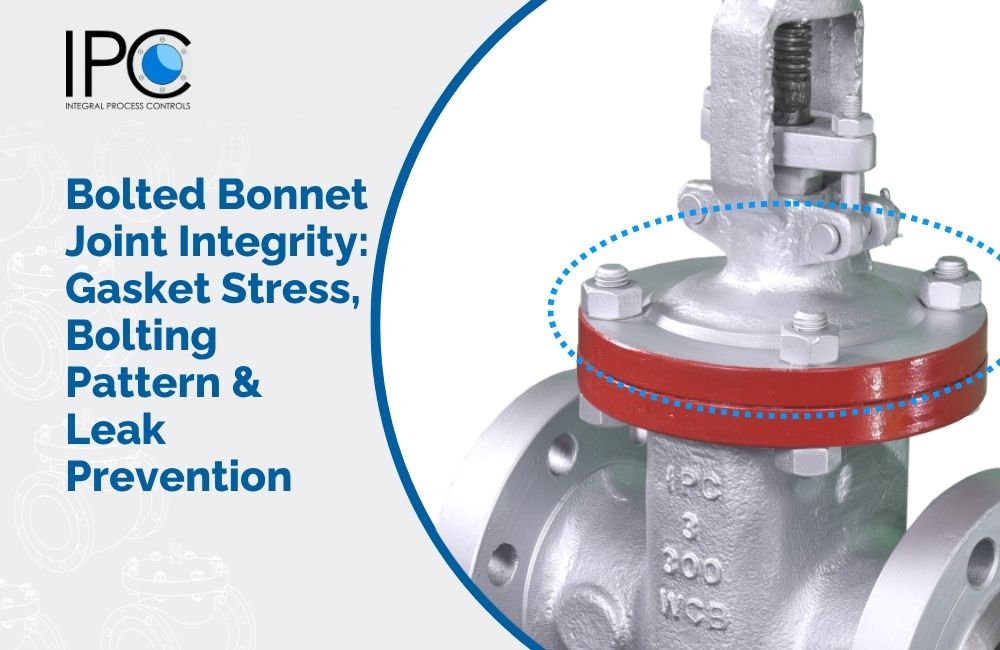
You’ve selected the right valve type, the correct material, and the proper end connections. But there’s one connection that can change everything, if it fails, even a reliable valve can start leaking: the bolted bonnet joint.
In Gate, Globe and Check valves, the bonnet is the removable cover that allows internal access for assembly and maintenance. Its joint with the valve body must withstand full system pressure, temperature cycles, and external piping loads – all while remaining leak-tight for years.
Yet bonnet joint leaks are surprisingly common. Why? Because achieving lasting joint integrity requires more than just tightening bolts. It demands controlled flange finishing, disciplined bolt tightening procedures, and documented pressure testing three areas where IPC excels. IPC’s systematic approach delivers bonnet joints you can trust in the toughest services – from power and oil & gas to chemicals and steel.
Why Bolted Bonnet Joints Fail
| Failure Mechanism | What Happens | Typical Result |
| Insufficient gasket stress | Bolt load too low → gasket not fully compressed | Immediate leak at low pressure |
| Uneven bolt tightening | Scatter in bolt preload → localized gasket relaxation | Leak after thermal cycles |
| Poor flange finish | Rough or wavy surface → gasket cannot conform | Persistent weepage |
| Gasket relaxation / creep | Over time, gasket loses thickness → bolt load drops | Leak after months in service |
| Thermal cycling | Differential expansion between bolts and body → load loss | Leak during startup/shutdown |
Gasket Stress – The “Sweet Spot” for a Perfect Sea
Typical gasket stress ranges (approximate):
| Gasket Type | Minimum Seating Stress (MPa) | Maximum Allowable Stress (MPa) |
| Compressed non-asbestos fiber (CNAF) | 20–30 | 60–80 |
| PTFE envelope / filled PTFE | 10–15 | 30–40 |
| Spiral wound (with inner ring) | 40–50 | 120–150 |
| Graphite sheet / corrugated metal | 15–25 | 50–70 |
The key: The bolt preload must generate a uniform gasket stress within this window across the entire gasket contact area. Too low? Leak. Too high? Gasket fails.
IPC’s engineering team calculates the required bolt torque for each valve size, pressure class, and gasket type – then verifies it during documented pressure testing.
Bolting Pattern & Tightening Sequence – Why Order Matters
You cannot simply tighten bolts in a circle. That creates uneven compression, bending the bonnet and leaving low-stress zones.
The correct method: star pattern (criss-cross) For a 8-bolt bonnet, for example:
- Tighten bolts 1, 3, 5, 7 (every other bolt) to 30% of final torque.
- Repeat with bolts 2, 6, 4, 8 to 30%.
- Repeat both sequences at 60%, then at 100% final torque.
Why this works: The star pattern distributes the clamping force progressively, preventing flange distortion and ensuring uniform gasket stress.
Additional best practices:
- Use calibrated torque wrenches or hydraulic tensioners – not “elbow torque”.
- Apply lubricant to bolt threads for consistent friction.
- Multiple passes (30% → 60% → 100%) allow gasket to relax gradually.
IPC’s disciplined bolt tightening procedures follow these rules for every bolted bonnet valve, from Class 150 to Class 2500.
Flange Finishing – The Unsung Hero of Joint Integrity
IPC’s controlled flange finishing includes:
| Parameter | Requirement | Why It Matters |
| Flatness (across flange face) | ≤ 0.2 mm per 100 mm diameter | Prevents bending stress on bolts |
IPC’s Uniqueness: Three Pillars of Bonnet Joint Integrity
A. Controlled Flange Finishing
B. Disciplined Bolt Tightening Procedures
- Written procedures for each valve size and pressure class.
- Star-pattern tightening in multiple passes.
- Torque tools daily calibrated.
C. Documented Pressure Testing
Every IPC valve undergoes:
- Shell (hydrostatic) test per ASME B16.34 – proves bonnet joint integrity at 1.5x rated pressure.
- Hydrostatic Seat Test
- Pneumatic seat test bubble-tight.
- Test reports include test pressure, duration, and a sign-off that no leakage was observed.
These three pillars eliminate guesswork and deliver bonnet joints that remain leak-free for decades.
Leak Prevention Beyond Manufacturing – Field Practices
Even a perfectly built valve can leak if field maintenance is sloppy. Follow these rules:
- Never reuse gaskets – always install new.
- Clean flange faces – remove old gasket material, rust, and debris.
- Use correct gasket type for the service (don’t substitute).
- Follow the same star-pattern tightening as factory.
- Consider belleville springs for high-temperature cyclic service – they maintain bolt load despite thermal expansion.
IPC supplies detailed bonnet joint maintenance guides with every valve – because leak prevention is a shared responsibility.
Trust IPC for Leak-Free Bonnet Joints
The bolted bonnet joint is not a weak point – if it is engineered, finished, tightened, and tested correctly. IPC’s controlled flange finishing, disciplined bolt tightening procedures and documented pressure testing turn the bonnet joint into a reliable, long-lasting seal.
Whether you need gate, globe, or check valves for power, oil & gas, chemicals, or Steel, IPC delivers joint integrity you can prove with test reports.
Request IPC’s bonnet joint integrity guide – a practical checklist for engineers and maintenance teams.
Contact IPC Valves today at www.ipcvalves.com or ask your local representative.