


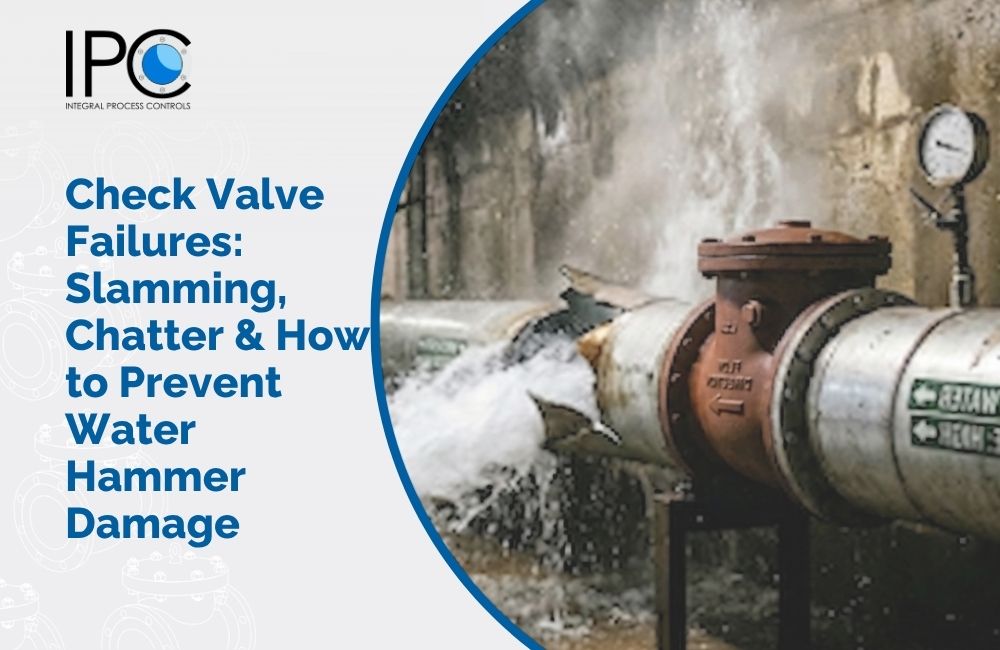
You’re walking through a pump station or a process plant. The pumps are running smoothly. Then you hear it: a loud BANG that echoes through the pipework. Or maybe a rapid clatter‑clatter‑clatter that sounds like someone shaking a toolbox. These aren’t normal operating noises. They are the sounds of check valve failure in progress.
Water hammer and valve slam are not just noisy nuisances. They generate pressure spikes that can burst pipes, damage pumps, rupture gaskets, and injure nearby personnel. Over time, even a “moderate” recurring slam will destroy the check valve internals, leading to reverse flow, loss of system integrity, and unplanned shutdowns.
At IPC, with over 25 years of manufacturing Check Valves (alongside Gate, Globe, and Ball Valves), we have helped plants across oil & gas, power, chemicals and water treatment eliminate these failures. The secret isn’t just buying a “better” check valve it’s matching the valve’s closing dynamics to your actual system operating conditions.
What Is Water Hammer? (And Why It “Slams”)
Water hammer is a pressure surge (shockwave) that occurs when a moving fluid is forced to stop abruptly. In a check valve context, this happens when the forward flow suddenly stops (e.g., a pump trips) and the check valve disc slams shut against its seat.
The physics is brutal: a 1 m/s flow stopped in 0.1 seconds can generate a pressure spike of 10–15 bar above the normal operating pressure. In larger pipes or higher velocities, the spike can exceed the pipe’s rating.
Slam is the specific failure mode where the disc or clapper hits the seat with excessive force, creating a single loud bang. Chatter is rapid opening/closing of the disc due to flow pulsations or unstable disc behaviour, creating a rapid hammering noise.
Term | Description | Consequence |
Water hammer | Pressure surge from rapid flow deceleration | Pipe rupture, flange leakage, instrument damage |
Slam | Single violent disc‑seat impact | Cracked disc, deformed seat, body fatigue |
Chatter | Rapid, repeated disc movement | Wear of hinge pins, seat erosion, seal failure |
Common Check Valve Failures – What Breaks and Why
When a check valve fails, it usually shows up as one of these symptoms:
- Excessive reverse flow (leakage past closed disc) – seat is worn or disc no longer seals.
- Persistent noise (slam or chatter) – disc dynamics unstable.
- Metal fragments in downstream strainers – internal parts (hinge pin, disc guide) have broken.
- System pressure spikes – the valve closes too fast (slam) or too slow (reverse flow then slam).
The root causes almost always trace back to incorrect valve type or size for the application, not a “bad” valve.
Slamming & Chatter – The Technical Breakdown
Slamming: A check valve slams when the disc closes too fast relative to the reverse flow velocity. This is typical when:
- The pump stops suddenly (electrical trip, power failure).
- The system has very long discharge piping– the reverse flow column is large and gains momentum.
- A swing check valveis used in a system with low forward velocity – the disc never fully opens, then slams from a partly open position.
Simple rule: The faster the reverse flow develops, the more likely a swing check will slam.
Chatter: Chatter is almost always a sizing and selection problem:
- Valve is oversized for the normal flow rate – the disc “hovers” near closed, fluttering open and shut.
- Pulsating flow(e.g., reciprocating pumps, compressors) – disc responds to each pulse.
- Low differential pressure – insufficient force to hold disc fully open.
Both slamming and chatter cause cyclic fatigue of the hinge, spring, and seat, leading to premature failure.
How to Prevent Water Hammer Damage – Practical Steps
Step 1: Do Not Guess the Valve Type
Many engineers default to “swing check because we always use them.” That is a recipe for slam. Instead, evaluate:
- Normal flow velocity– too low? Swing check may never open fully.
- Pipe length downstream of pump– longer = more reverse flow momentum.
- Pump type– centrifugal (gradual stop) vs. reciprocating (pulsating flow).
Step 2: Apply the “Closing Dynamics” Selection Rule
If your system has… | Recommended Check Valve |
Short pipe run, low velocity, non‑critical | Swing check (with lever & weight to assist closure) |
Medium pipe, moderate water hammer concern | Dual plate check – best all‑rounder |
Long pipeline, high velocity, sudden pump trip | Single plate (nozzle) check – fastest closure |
Reciprocating pump or compressor | Single plate or spring‑assisted dual plate |
Step 3: Size Correctly – Never Oversize
An oversized check valve will chatter itself to death. Use the actual minimum and maximum flow rates, not just pipe size.
Step 4: Install with Care
- Swing checks need horizontalpiping (or vertical flow‑up) to work correctly.
- Dual plate checks are orientation‑flexible, flow direction must match the arrow on the valve body.
- Leave enough straight pipe upstream (5–10 diameters) to avoid turbulence.
Our 25+ years of field experience across power, oil & gas, chemicals, and water means we have already solved the problem you are facing today.
Every plant is unique. Do not wait for a pipe to burst or a pump to break. Let IPC’s application experts recommend the right check valve for your actual operating conditions Contact us or drop us a mail on evalve@ipcvalves.com for your application requirement.